
Reverse predictivity for bidirectional comparison of neural networks and biological brains
Published in Nature Machine Intelligence, 2026
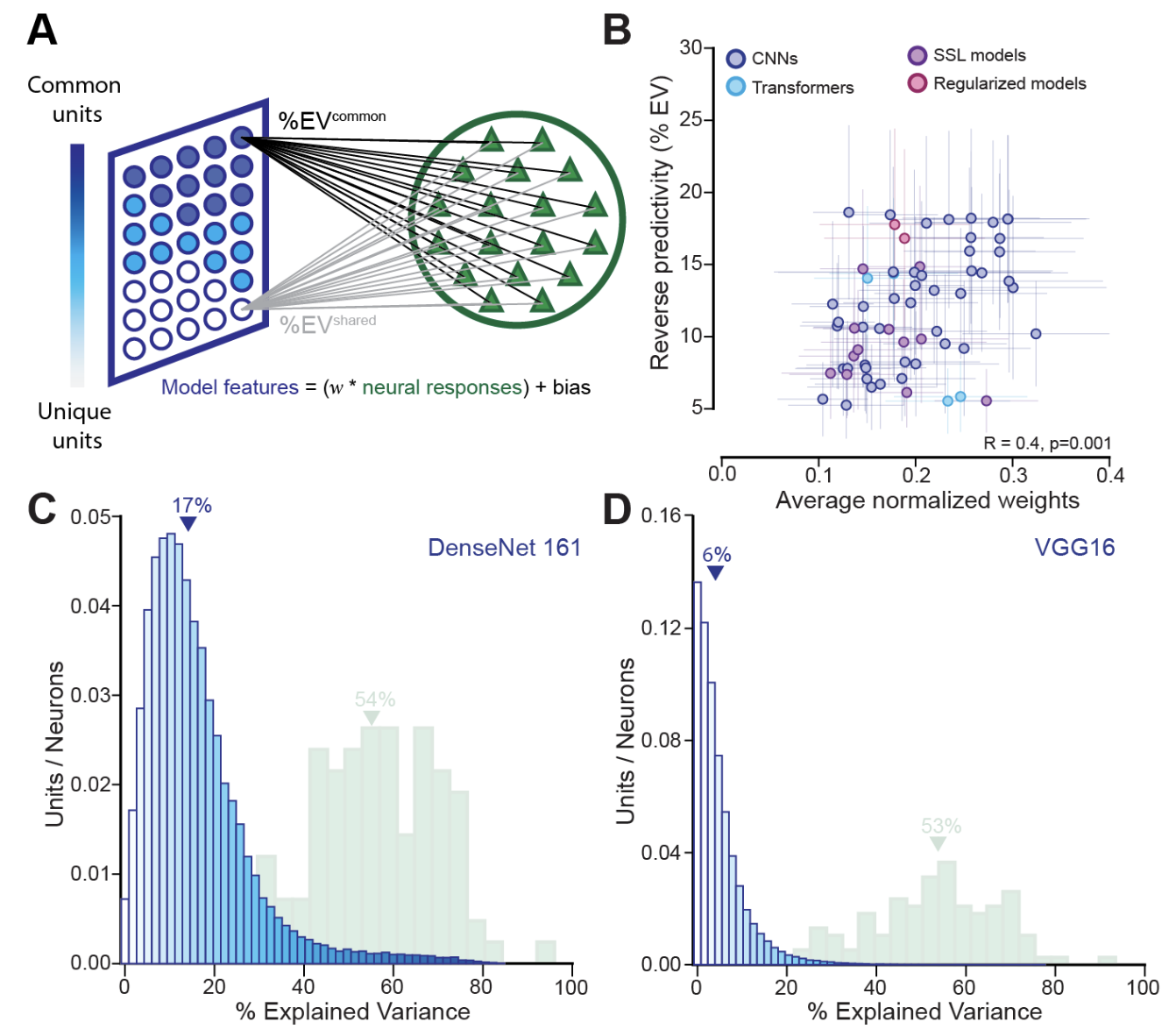
A major goal in systems neuroscience is to build computational models that capture the primate brain’s internal representations. Standard evaluations of artificial neural networks (ANNs) emphasize forward predictivity—how well model features predict neural responses— without testing whether model representations are themselves predictable from neural activity. Here we develop the reverse predictivity metric, which quantifies how well macaque inferior temporal (IT) cortex responses predict ANN unit activations. This two-way framework reveals a striking asymmetry: models with high forward predictivity (~50% variance explained) often contain units unpredictable from neural activity, reflecting biologically inaccessible dimensions. In contrast, monkey-to-monkey mappings are symmetric, confirming that the asymmetry reflects genuine representational mismatch. Reverse predictivity isolates “common” ANN units—shared with IT, behaviorally relevant, and generalizing across species—and “unique” units lacking such alignment. Influenced by feature dimensionality, training objectives, and adversarial robustness, reverse predictivity offers a principled benchmark for guiding next-generation ANNs toward both high task performance and genuine biological plausibility.
Recommended citation: Muzellec, S. & Kar, K. (2026). Reverse predictivity for bidirectional comparison of neural networks and biological brains. Nature Machine Intelligence, 8(3), 474-488.
PDF GitHub Data